Tune Out the Hype: A Tactical Look Before You Panic Buy
Headlines, viral posts, and YouTube thumbnails are pushing people back into the stores. Here’s how to check what’s actually happening where you live before you spend a dime.

If you listened to this week’s episode, Panic Buying Versus Preparedness, you know I’ve been watching something build. Since last week there’s been a steady rise in news stories, social media posts, and YouTube videos all pushing the same feeling: something big is coming, and if you don’t buy it now, it’ll be gone.
Some of that content starts from a reasonable place. Government emergency kit advice is good advice. Military bases planning to be ready for 90 days is just what you’d expect a military to do. But by the time it’s been clipped, captioned, and reposted a few hundred times, sensible guidance turns into a countdown clock. And a countdown clock is exactly what sends people into the store to fight over the last case of water.
This article is the follow-up to the episode. I want to give you a way to take a tactical look at what’s really going on, so you can make decisions based on facts about your own address instead of somebody else’s thumbnail.
How the hype machine works
I spent 26 years as a cop. A lot of that job was sorting out what actually happened from what people were sure had happened. The two are rarely the same, and the gap between them is usually filled with fear and repetition.
Online, it works like this. Somebody posts a real headline. Somebody else adds a prediction the headline never made. A third person makes a video about the prediction. Now you’ve seen the “same story” from three places, and your brain counts that as confirmation. It isn’t. Repetition is not confirmation. Three people repeating one guess is still one guess.
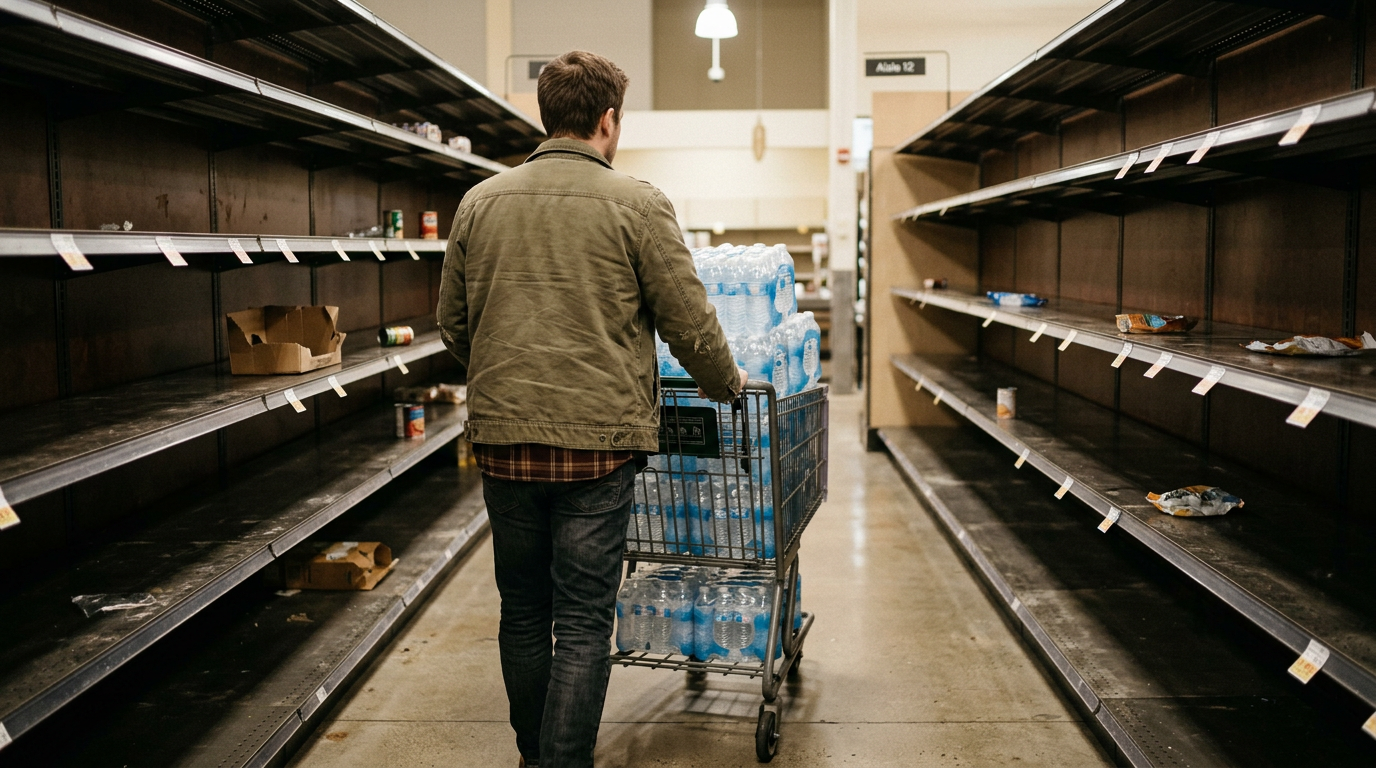
Then you walk into the store and see a couple of empty shelves. That’s the visual confirmation I talked about on the show, and it’s powerful. Your brain stops asking “Is this real?” and starts asking “How much can I fit in the cart?” That’s the moment reasonable concern turns into an expensive sprint.
Two households, same headline
Picture two families who see the same scary post on a Tuesday night.
The first family checks. They look at what’s actually being reported for their area, glance at their pantry, and notice they’re low on two things. They add those to the regular grocery list for the weekend. Then they go to bed.
The second family reacts. They drive to two stores, pay whatever’s on the tag, and come home with a trunk full of things they grabbed because other people were grabbing them. They spend a few hundred dollars, maybe on a credit card. And when they finally sit down, they realize they still don’t have the prescription refill, the flashlight batteries, or the plan for the kids that they actually needed.
Same headline. One family got a little more prepared. The other got poorer and more stressed. The difference wasn’t money or gear. It was having a way to check before reacting.
Check before you react
This is where I want to point you to something I use myself: the BeAware dashboard from BePrepared Solutions. The reason it fits this conversation is simple. It doesn’t show you what’s trending. It shows you what official sources are reporting for your actual address.
BeAware watches more than 20 official sources and matches them to where you live. Federal emergency alerts and National Weather Service warnings, utility outages, wildfire perimeters, internet and cell outages, and air and water conditions, all in one place and in plain English. The newer version adds satellite heat detection, global storm tracking, evacuation routes, emergency radio, and a 3D view of your street.
Here’s why that matters for panic buying. When a video tells you “the grid is going down” or “a supply disaster is coming,” you can open the dashboard and look. Are there outages near you? Warnings? Anything at all moving toward your county? Most of the time, the answer is a quiet map. That quiet map is worth more than any amount of reassurance from me, because it’s your area, your data, right now.
And when something real is headed your way, you’ll see it from an official source, early, with time to act calmly instead of in a crowd.
A tactical check you can do in ten minutes
Next time a headline gets your heart rate up, run through this before you grab your keys:
- Find the original source. Not the video about the article. The actual article, agency, or report. Read what it really says, and notice what it doesn’t say.
- Check your address. Open your dashboard and look for real warnings, outages, or hazards near you. No local signal usually means no local emergency.
- Ask the time question. Is this happening tonight, this month, or “someday”? “Someday” problems get solved with a shopping list, not a shopping spree.
- Look at your own shelves. Count what you already have. Most people are better stocked than the fear tells them.
- Write down the real gaps. Medications, water, light, a way to charge phones, and cash are where most families come up short.
- Sleep on any big purchase. If it still makes sense in the morning, buy it at a normal price on a normal day.
Buy slowly, on purpose
The best time to buy supplies is when nobody else is. Prices are normal, shelves are full, and you’re thinking clearly. A little extra on each grocery trip adds up faster than you’d expect, and it never puts you in debt or in a parking lot fight.
Focus on the things that actually carry a household through a disruption. Water first. Then food you already eat and will rotate through. Then medications, light, power for communication, and a simple plan for what you’ll do if the power, phones, or stores are down for a while. Everything on that list gets more useful with a plan, and less useful in a panic.
If you want help turning that into an actual plan for your family, the Resources page has the tools I recommend, including BeReady for building a household plan step by step.
Be the calm one in the room
On the episode I said I want you to be the person calmly drinking coffee while everyone else competes for the last case of water. That calm doesn’t come from being fearless. It comes from knowing what’s actually happening and knowing you’ve already handled the basics.
The noise isn’t going away. There will be another scary headline next week and another viral video the week after that. You can’t control the hype. You can control whether you check before you react.
If you want to try that for yourself, BeAware has a free seven-day trial, no credit card required, at bepreparedsolutions.co. Set up your address, look around the dashboard, and the next time the internet tells you to panic, take a look at your own map first. Odds are, you’ll finish your coffee.