GMRS vs. FRS: Which Radio Is Right for Your Family?
Since the off-grid comms episode, my inbox has filled up with one question: “Which walkie-talkie should I buy?” Let’s set ham, push-to-talk, and satellite aside and look at the two simplest radios you can buy, what makes them different, and which one fits your family.
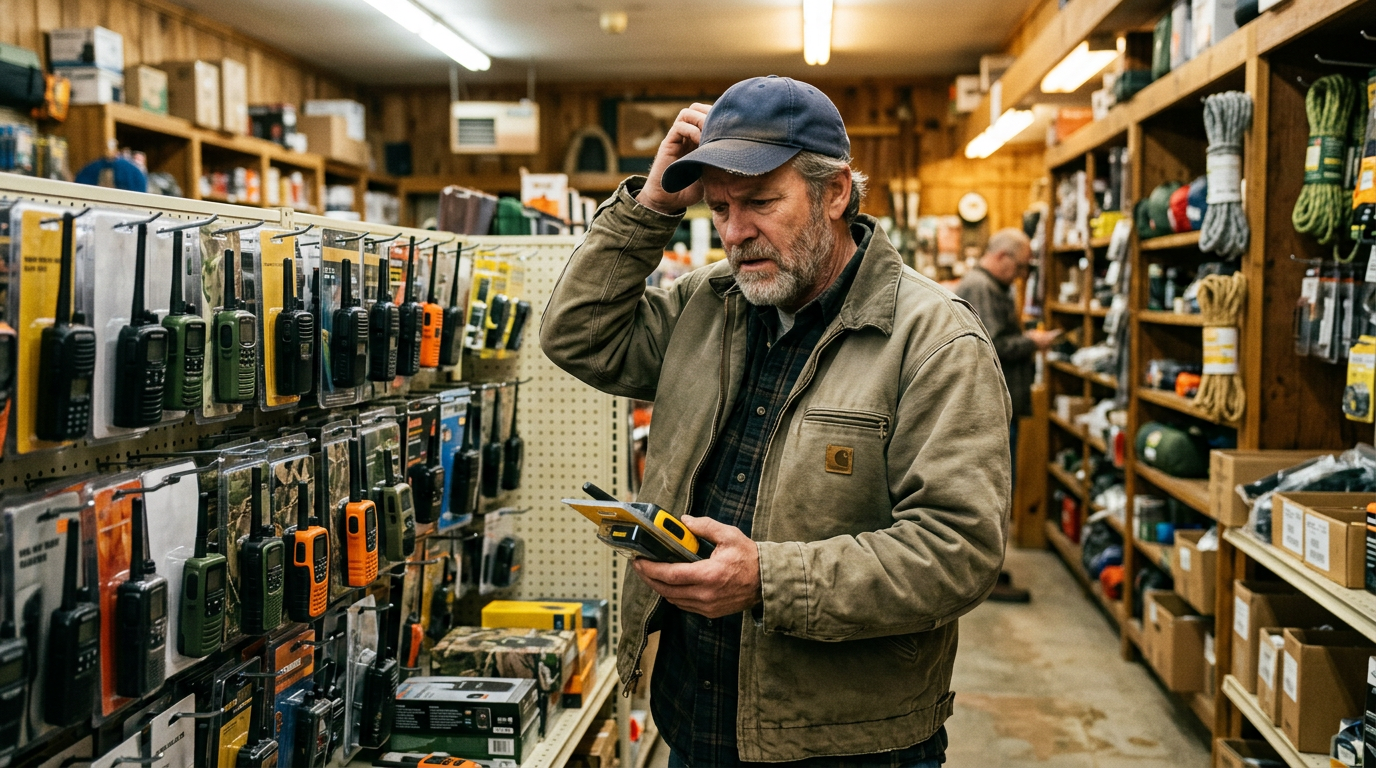
Over the last two or three weeks I’ve gotten a stack of emails since the off-grid comms episode and my article on grid-down communications. Most of them boil down to the same thing: “Keith, I went to the store, there was a whole wall of radios, and I walked out with nothing because I had no idea what I was looking at.”
I get it. The packaging is loud, the numbers are confusing, and every box promises 35 miles.
There are plenty of other options out there. Push-to-talk over cellular (PoC) radios, ham radio, and satellite messengers and phones all have their place, and I covered them in the comms episode. But they come with more cost, more setup, or more learning. Today we’re going basic: the two simplest, most affordable radios most families will start with, FRS and GMRS.
The short version
FRS is the grab-and-go walkie-talkie. No license, no setup, anyone in the family can use it. GMRS is its bigger brother. It needs an inexpensive license, but you get more power, better antennas, and the option to use repeaters for much longer range.
They share the same 22 channels, so an FRS radio and a GMRS radio can talk to each other. That matters, and we’ll come back to it.
FRS: the Family Radio Service
These are the blister-pack radios you see at big box stores, often sold in pairs. They’re cheap, simple, and built for families, hunters, campers, and neighbors.
- No license required. Kids can use them.
- Power is capped at 2 watts on most channels and half a watt on channels 8 through 14.
- The antenna is fixed. You can’t swap it for a better one.
- No repeaters. It’s radio to radio only.
- Realistic range is usually a half mile to two miles, depending on terrain, trees, and buildings.
GMRS: the General Mobile Radio Service
GMRS uses the same frequencies but lets you do a lot more with them.
- A license is required, but there’s no test. You apply through the FCC, it costs $35, and it lasts 10 years.
- One license covers your immediate family, so your spouse and kids can use the radios under your call sign.
- Handhelds usually run up to 5 watts. Mobile radios in a truck or base station at home can run up to 50 watts on the main channels.
- Detachable antennas, so you can add a better one on the radio, the vehicle, or the house.
- Repeater access. A repeater on a hill or tower can stretch your range to 20 miles or more.
- Realistic range on a handheld is a mile or two up to about five. With a good mobile or base antenna, or a repeater, it can be much more.
About that “35 miles” on the box
Let’s clear this up, because it’s the number one reason people get frustrated. That 35-mile claim is a best-case number, like from one mountaintop to another with nothing in between. In the real world, trees, hills, buildings, and even the inside of your car cut that way down.
Radio at these frequencies is mostly line of sight. Height beats power. Standing on a hill or getting your antenna up on the roof will often do more than buying a stronger radio.
Privacy codes aren’t private
Many radios advertise “privacy codes.” All they do is filter out other people so you don’t hear them. Anybody on that channel without the code can still hear you. Encryption isn’t allowed on FRS or GMRS, so treat everything you say as public. Don’t broadcast that you’re away from home or where you keep your supplies.
Which one should you buy?
Here’s how I’d think about it:
- Pick FRS if you want something simple for the kids, the campground, the hunting cabin, or talking across the property. No paperwork, and it just works.
- Pick GMRS if you want to reach family across town, run a radio in the truck, put an antenna on the house, or use a local repeater.
- Or do both. Get a GMRS license and a couple of GMRS radios for the adults and vehicles, and hand the kids FRS radios. Because they share channels, everyone can still talk.
What to look for on the shelf
When you’re standing in front of that wall of radios, skip the mileage claims and look for these instead:
- Check the box for “FRS” or “GMRS.” If it says GMRS, it may need a license to use at full power. Some combo radios list both.
- Look at the battery. Radios that take AA or AAA batteries, or come with an adapter for them, are easier to keep running when the power is out.
- Weather alerts. Many radios can tune NOAA weather radio channels, and some will sound an alarm when a warning is issued. That’s a nice bonus.
- Water resistance. If it’s going in the truck, the barn, or a bug-out bag, it’s worth paying a little more for a rugged, water-resistant radio.
- Buy at least two of the same model to start. Matching radios make setup and teaching the family a lot easier.
- For GMRS, check whether the antenna comes off. A removable antenna is what lets you upgrade later.
Make a simple family plan
A radio in a drawer is only half the job. Sit down with your family and decide a few things ahead of time:
- Pick a primary channel and a backup channel, and write them down.
- Choose check-in times, like the top of every hour, so you aren’t draining batteries listening all day.
- Keep radios charged and store spare batteries. Radios that run on AA batteries are a big plus when the power is out.
- Practice. Take the radios on a walk around the neighborhood and see how far you can actually talk.
- If you get a GMRS license, say your call sign at the end of a conversation and at least every 15 minutes while you’re talking.
Start simple
You don’t need the fanciest gear to stay in touch. A pair of basic radios, a plan, and a little practice will put you ahead of most households when the cell towers go quiet. When you’re ready to go further, ham radio, push-to-talk, and satellite options are still there, and we’ll get back to them.
Keep the emails coming. They’re how I know what to write next. No fear, no gatekeeping. Just common sense.